Our Approach & Outcomes

Young people should have a genuine say in the places they grow up in. This is our approach to achieve that.
Young people should have a genuine say in the places they grow up in. This is our approach to achieve that.
The systems that govern our communities were built to hold power, not share it, and young people have always been among those left out. The Young Mayors program works inside local government to change who gets to shape it by electing Youth Councils, partnering with council champions to build meaningful change from within, and grounding the work in First Nations governance approaches that have shaped this land over thousands of years.
The goal: young people have a genuine say in the places they grow up in, and decision-making processes reflect all perspectives.
Early insights from our first stage of evaluation tell us:
Local government has welcomed the Young Mayors model
Creating strong future local leaders relies on engaging young people now
Young people embrace the mandate to represent their community
Communities are equipped to engage young people in democracy
When given the platform, young people are highly engaged
Local government is an important forum for young people to make change
Local government needs support and ideas to engage young people
Community sentiment and dialogue is shifting as an outcome of the model
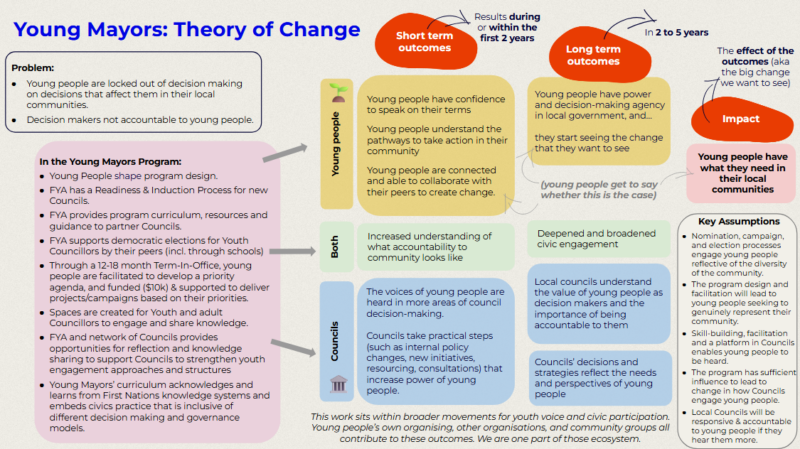
The Young Mayors program exists to address a gap: young people are locked-out of decisions that affect them in their local communities.
Through our Theory of Change, our aim is to create positive change for both young people and our partner Councils. We’re still testing our theory and our approach, embedding key design features into the program including that:
As a result of this, we expect to see:

Young people must be involved in making decisions that impact their own lives in their own communities.1
The Young Mayors model works with local councils to democratically elect Youth Councils. We work at the local government level because it is the closest tier of government to the people.
We recognise that governance, power and decision-making are mechanisms that societies use to organise themselves, allocate resources and make collective choices.
We know for our democracy to work for us all, it must include us all. Incredible opportunities exist when all parts of the community are empowered to share power and participate in decision-making.2
When systems are designed to include young people from all parts of the community, all people benefit.3
The systems of government in Australia exclude many groups of people, including young people and First Nations people and their communities.4 Particular groups of people have the most power and influence. This is because of the Westminster system and wider colonial systems used in Australia.5 The Young Mayors model exists to change who has power and influence.
The Young Mayors model is designed to operate within the institutional system of local government, working with local council champions to make change from the inside. By creating structured opportunities for young people to participate in civic processes,6 the program seeks to broaden who is included in decision-making and how decisions are shaped.
Recognising the limitations of working within local government, Young Mayors commits to recognising and learning from First Nations governance models, and to forming strong, collaborative relationships with Traditional Owners and community leaders.7
Over time, this approach aims to redistribute youth voice and influence within local governance, supporting councils and institutions to ensure a more inclusive, participatory and representative model of leadership and local accountability.
Through the Young Mayors model, young people are elected by their peers. We use Australia’s existing electoral processes to prepare young people to participate in the prevailing system, and use democracy as a mechanism to encourage robust and respectful dialogue, strengthen community participation and collective action, and practise transparency and accountability.
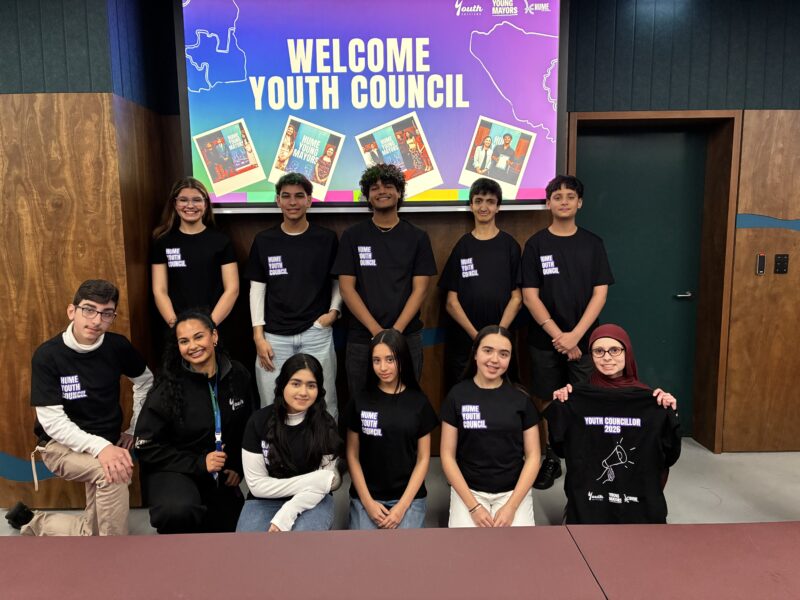
By being elected, young people are given a clear role to represent the views, experiences and aspirations of their communities. Young people are as diverse as the communities that raise them, and that requires the model to meet young people where they are.8 By working with local council staff and elected councillors, and with a budget allocation, the Youth Council is supported to be a legitimate decision-making group that is relevant to their local context.
The model is designed to move away from a traditional advisory mechanism to empower young people to turn ideas into action and actively participate in civic life, ensuring their perspectives inform local policy and community priorities.
In all aspects of our work, our goal is to form meaningful partnerships with local councils, schools, community organisations, Traditional Owners, First Nations young people and local stakeholders.
Together, we take a place-based approach that recognises the unique strengths, histories and needs of each community.9 While guided by a national best-practice curriculum and methodology, the program is shaped locally. This ensures it is responsive to local needs, challenges and opportunities and that young people are engaged with the issues that matter most in their own communities.
Together this enables the development of practical pathways to influence change.

1 Young people connected to Accountable Futures Collective, Defining Accountability Report May 2026
2 Why Participation Matters, UNICEF Explainer
4 Australian Human Rights Commission Assessment, Aboriginal and Torres Strait Islander Peoples 2026
5 Yoorook Justice Commission, The Impacts of Colonisation
6 Growing Up in Australia – The Longitudinal Study of Australian Children, June 2026
7 How can government better engage with Traditional Owners? To be heard and for the words to have actions: Traditional Owner voices report by First Peoples – State Relations, 2019
8 NextGen Blueprint: Every generation has a role report by FRRR July 2026
9 Place-based initiatives in Australia report by ARACY February 2023
Through a three-year pilot, the Young Mayors model has shown strong engagement from young people, local government, the community and the media demonstrating the program has huge potential to make long-term, systemic change.
Early insights from our evaluation tell us that:
When given the platform, young people are highly civically engaged
Participation in the program increases Youth Councillors’ confidence, motivation, and opportunities to speak up on issues that matter to them and their peers. It also opens doors for further civic engagement from young people and leadership opportunities for youth councillors. Young people also report feeling more connected to their local areas through their involvement in the program.
Participation in the program increases Youth Councillors’ confidence, motivation, and opportunities to speak up on issues that matter to them and their peers. It also opens doors for further civic engagement from young people and leadership opportunities for youth councillors. Young people also report feeling more connected to their local areas through their involvement in the program.
Communities are equipped to engage young people in democracy
Across the six local government areas, 70+ schools and community centres host polling places, with many teachers using the program as part of their civics curriculum to prepare students for voting.
Young people embrace the mandate to represent their community
In Australia 167 young candidates under the age of 17 have engaged in campaigning, with 83 elected to serve Terms in Office.
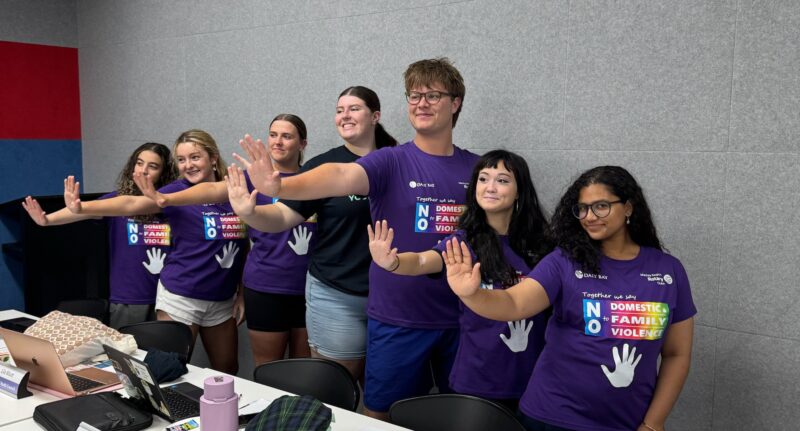
Along with representing their constituents locally, elected Youth Councillors have opportunities to represent at a state and national level. This has included:
Local communities have welcomed the Young Mayors model
Young Mayors is embraced as a ‘whole of community’ activity and its outcomes reach far into each region. Nationally, 137 Local Councils are interested in Young Mayors, with six spots in the pilot and community support from Traditional Owners and land councils, along with libraries and community centres hosting polling places.
Local government is an important forum for young people to make change
Youth Councillors’ perceptions of Council have shifted through their involvement in the Young Mayors model. Initially unsure about what councillors do and how the Council works, after the program they have a better understanding of the Council’s responsibilities and appreciate the complexities of the role.
Following their election, Youth Councils undergo a thorough induction process grounded on Country. Their induction covers power sharing, responsibility as an elected leader and strategies for ongoing community consultation, providing the framework for Youth Councils to begin addressing community priorities with a $10,000 Youth Fund to be used in their Term in Office.
Creating strong future local leaders relies on engaging young people now
The Young Mayors model provides real world opportunities for young people to develop and practice leadership skills throughout the program, from running a campaign, to experiencing success or defeat, understanding how to support themselves, making way for others and building resilience for life.
The Young Mayors model incorporates a strong community outreach approach, working with organisations and schools to identify young people with lived experience to empower a wide range of young people to participate.
Supporting young people to develop skills and apply them in a local context provides strong role modelling for community leaders of all ages, builds confidence that the future is in safe hands, and creates a pipeline of diverse young people who will one day take on leadership roles as adults.
Local government wants support and ideas to engage young people
Council champions are crucial to successfully reduce participation barriers for young people and embed them in decision-making processes; and more champions are needed.
The Young Mayors model offers a way of working with young people that centres their ideas and perspectives. Councils have consulted their Youth Council on multiple projects and gained valuable input on plans, events, and communications. Young people have helped identify gaps, raise awareness of Council initiatives and bring fresh, practical ideas.
Community sentiment and dialogue is shifting as an outcome of the model
50+ positive media stories have been published and broadcast in local, state and national news across three years, most of which have occurred organically. These stories help to change the narrative from young people as the problem to young people as the solution. The media have focused on the ways in which young people are making a difference in their local community and helping to build momentum for other young people to fully engage in civic life.